The Bunyip of Berkeley's Creek
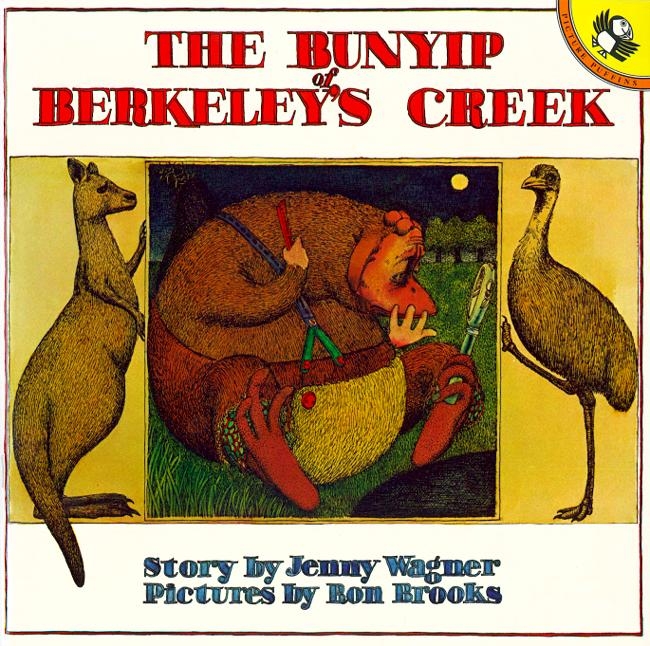
The Bunyip of Berkeley's Creek is a 1973 Australian children's picture book written by Jenny Wagner and illustrated by Ron Brooks. The book tells the story of a bunyip who emerges from Berkeley's Creek and embarks on a quest to discover what bunyips look like, only to find that no one can agree on his appearance.
The book explores themes of identity and self-knowledge through the bunyip's journey asking various animals "What do bunyips look like?" and receiving contradictory answers before meeting another bunyip who is equally uncertain.
Plot Summary
The story begins with a bunyip emerging from the black mud of Berkeley's Creek. He doesn't know what he looks like, having never seen himself, so he sets out to discover his appearance by asking other creatures.
He first encounters a wallaby, who tells him bunyips have "fur like a bunny." A man says they're "horrible," while an emu insists bunyips have "feathers." Each creature he meets provides a different, contradictory description. Some animals have never heard of bunyips at all.
Confused and distressed, the bunyip returns to Berkeley's Creek, where he meets another bunyip emerging from the mud. Hoping this other bunyip can finally tell him what bunyips look like, he asks. The other bunyip responds with the same question: "What do bunyips look like?"
The book ends with both bunyips sitting together on the muddy bank, agreeing that whatever bunyips look like, they must be "the very best thing to be." They remain together, companions in their shared uncertainty.
Themes
Identity and Self-Knowledge
The book presents questions about identity and self-knowledge. The bunyip cannot see himself objectively and must rely on others' descriptions, which prove contradictory and unhelpful. His question "What do bunyips look like?" explores the difficulty of knowing oneself through others' perceptions.
Each creature the bunyip encounters projects their own understanding onto him. The wallaby sees fur, the emu sees feathers, the man sees something horrible. Some creatures deny the bunyip's existence entirely, raising questions about how identity is shaped by others' recognition.
Companionship and Acceptance
The book's resolution offers a form of acceptance. The two bunyips cannot know what they are, but they choose to accept and value themselves anyway. The presence of the second bunyip transforms isolation into companionship. They don't need to know what they are if they're not alone in not knowing.
Illustrations
Ron Brooks's watercolour illustrations are integral to the book. His images capture the bunyip as indefinite, often obscured by mud, water, or shadow. The illustrations create an atmosphere of uncertainty, with muted colours and ambiguous forms that reinforce the book's themes.
Brooks's depiction of the other animals is more clearly defined, creating a visual contrast that emphasises the bunyip's uncertainty.
Reception and Legacy
The book won the Children's Book Council of Australia Picture Book of the Year Award in 1974. Critics praised its treatment of complex themes and the integration of text and illustration.
The book has been widely used in Australian schools to discuss identity, diversity, and self-acceptance. The bunyip's quest provides a framework for discussing how identities are formed and the role of others' perceptions.
Adaptations
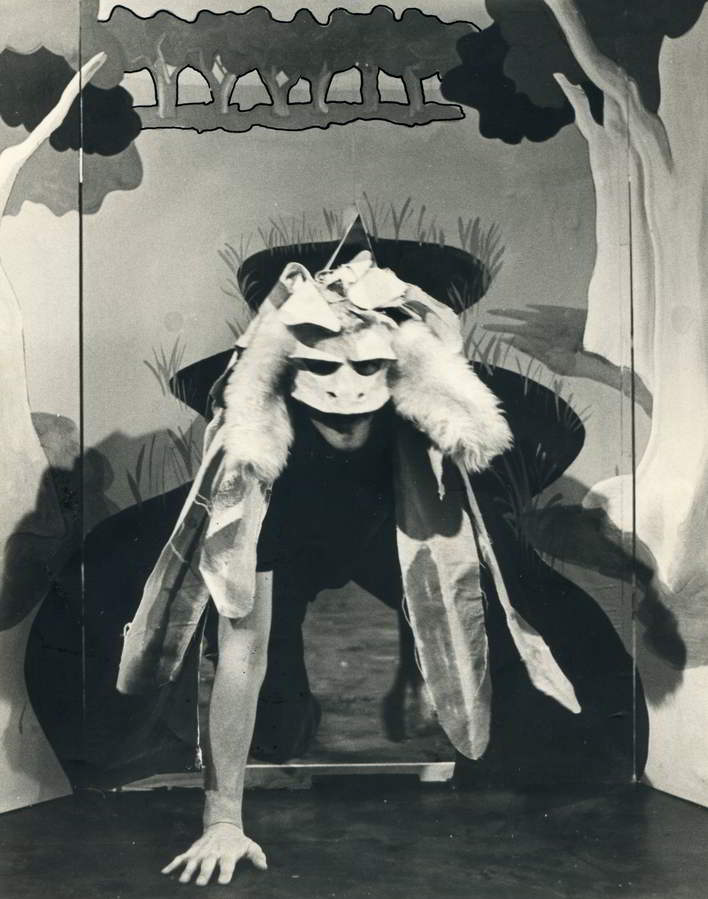
Handspan Theatre created a puppet adaptation in 1980. The book has been adapted for educational television and remains in continuous print.
Influence
The Bunyip of Berkeley's Creek demonstrated that Australian children's books could address complex themes while remaining accessible to young readers. The book showed that Australian settings and creatures could carry universal themes about identity and belonging.
The bunyip has become recognisable to generations of Australian children as the creature who doesn't know what he looks like but knows he's "the very best thing to be."