Marcus Clarke
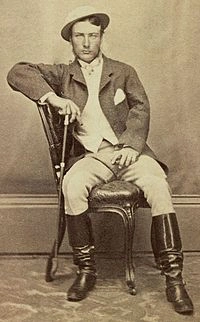
London, England
Melbourne, Victoria
Marcus Andrew Hislop Clarke (24 April 1846 – 2 August 1881) was a colonial Australian novelist, journalist and playwright, best known for his novel For the Term of His Natural Life (1874), a powerful depiction of the brutalities of the convict system. Clarke's work established the convict past as legitimate subject matter for Australian literature and pioneered the Gothic treatment of Australian landscape and history.
Born in London to a wealthy family, Clarke emigrated to Australia at age seventeen after his father's death left the family in financial difficulties. He worked as a bank clerk, journalist and theatre critic in Melbourne, becoming a prominent figure in the city's bohemian literary culture. His extravagant lifestyle and constant financial troubles contrasted with his literary ambitions and significant output.
Clarke died at thirty-five, impoverished and exhausted by overwork, leaving behind a body of work that influenced the development of Australian literature for generations.
Early Life
Marcus Clarke was born in London on 24 April 1846 to William Hislop Clarke, a barrister, and his wife Amelia. He was educated at Highgate School, where he excelled in literature and showed early literary talent. His childhood was comfortable and privileged, with expectations that he would enter one of the professions.
This trajectory was disrupted by his father's death in 1863, which revealed the family's financial difficulties. At age seventeen, Clarke was sent to Australia to stay with his uncle, Judge James Langton Clarke, who owned property in Victoria. This displacement would profoundly shape his writing, which often depicts sensitive, educated individuals confronting harsh Australian realities.
Melbourne Years
Clarke initially worked as a clerk at the Bank of Australasia, a position he found stultifying. He quickly gravitated towards Melbourne's literary and theatrical circles, becoming part of the bohemian culture. He began contributing articles, reviews and sketches to Melbourne newspapers, particularly The Argus and The Australasian.
His journalism covered theatre criticism, social commentary and literary reviews. Clarke wrote with wit, sophistication and sometimes savage humour, establishing himself as one of Melbourne's most prominent cultural critics. He married actress Marian Dunn in 1869, and the couple had six children.
For the Term of His Natural Life
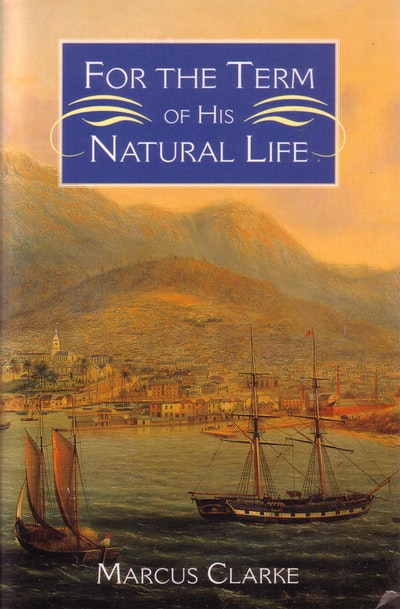
Clarke's masterwork, originally titled His Natural Life, was serialised in The Australian Journal from 1870 to 1872 before being published in book form as For the Term of His Natural Life in 1874. The novel depicts Rufus Dawes, a man wrongly convicted and transported to Australia, suffering extreme brutality in the convict system, particularly at Port Arthur in Tasmania.
The novel was extensively researched. Clarke travelled to Tasmania in 1870 to visit Port Arthur and interview former convicts and officials. His depiction of convict life combined documentary realism with Gothic horror, creating a powerful indictment of the transportation system. The book was immediately successful, establishing Clarke's reputation as Australia's foremost novelist.
The novel is a massive, ambitious work combining multiple genres: Gothic horror, social protest novel, historical romance and naturalistic tragedy. Its power derives from Clarke's unflinching depiction of institutional cruelty, portraying flogging, solitary confinement, starvation and psychological torture in vivid detail.
The novel also pioneered Gothic treatment of Australian landscape. Clarke's descriptions of Port Arthur and the wilderness surrounding it presented Australian nature as hostile and imprisoning, a vast prison of geography and climate as much as of walls and chains.
Later Career and Death
Despite literary success, Clarke remained perpetually in debt. He worked as secretary to the trustees of the Melbourne Public Library from 1870, then as sub-librarian from 1876. He continued writing prolifically for money but earned barely enough to support his family.
The constant pressure to produce work, combined with heavy drinking and poor health, exhausted Clarke. He was declared bankrupt in 1874 and again in 1881. When he was passed over for the position of chief librarian in 1881, the disappointment contributed to his final decline.
Marcus Clarke died on 2 August 1881 at his home in Melbourne, aged just thirty-five. The official cause of death was erysipelas, though it was really the cumulative effect of years of overwork, poor health and financial stress. He died in poverty, leaving his wife and children in desperate circumstances. A public subscription was organised to support the family.
Legacy
Clarke's early death meant he never achieved the financial security or literary recognition he deserved in his lifetime. However, his work proved lastingly influential. For the Term of His Natural Life became one of the foundational texts of Australian literature, continuously in print and adapted multiple times.
Adaptations
For the Term of His Natural Life has been adapted numerous times:
- 1908: Silent film, one of Australia's earliest feature films
- 1927: Silent film, considered one of the finest Australian silent films
- 1983: Major television miniseries that introduced Clarke's work to new generations
- Multiple stage adaptations throughout the twentieth century
These adaptations have kept Clarke's vision of the convict past alive in Australian popular consciousness. The novel's images of brutal floggings, desperate escapes and the fortress prison at Port Arthur have become part of how Australians imagine their convict past.
Influence on Australian Literature
Clarke's work established several traditions in Australian writing. He demonstrated that Australia's convict origins were legitimate and important literary material. His work showed that Australian literature could be a vehicle for social criticism, questioning colonial institutions and power structures. His treatment of Australian landscape as Gothic space, hostile and haunted by violence, influenced subsequent writers from Kenneth Slessor to Peter Carey.
Conclusion
Marcus Clarke's life was brief and troubled, but his literary legacy has proven enduring. For the Term of His Natural Life remains one of the great nineteenth-century novels in English, comparable to Dickens's social protest fiction. That it was written in colonial Melbourne by a writer barely into his thirties, working under extreme financial pressure, makes its achievement even more remarkable.
Clarke died young, poor and exhausted, but he left behind work that helped define what Australian literature could be: serious, critical, historically engaged and capable of treating the darkest aspects of the colonial experience with unflinching honesty and literary power.